Fractionation units, pipelines, and storage terminals: photographing them right takes more than a camera. Here is what it takes to capture Harris County's industrial scale.
If you have received a batch of photos from a shoot at your facility and thought, “These make our plant look like a toy,” you already understand the problem. Photographing a fractionation unit or a storage terminal is not the same discipline as photographing a boardroom or a product on a table. The scale is different. The environment is different. The stakes are different.
Harris County sits at the center of one of the concentrated industrial zones on the planet. The Houston Ship Channel corridor alone handles more than 230 million tons of cargo annually and contributes $15 billion in annual export value. The photography that represents these facilities needs to match that reality. We walk through what it takes to do it right.
Most commercial photographers are trained to control their environment, such as a studio, a conference room, or a product table. Industrial photography flips that. You are working inside an active facility where the environment controls you.
Timing is governed by operational schedules. Access is determined by safety credentials and permit-to-work systems. The light is wherever it is, and the structure you are photographing might be fifteen stories tall and a quarter-mile long.
The gap between a competent commercial photographer and a capable industrial photographer is not about gear. It is about understanding what you are walking into before you arrive on site. That means knowing how industrial facilities operate, what safety protocols look like in practice, and how to compose an image that communicates scale, precision, and operational complexity, not just a big metal thing.
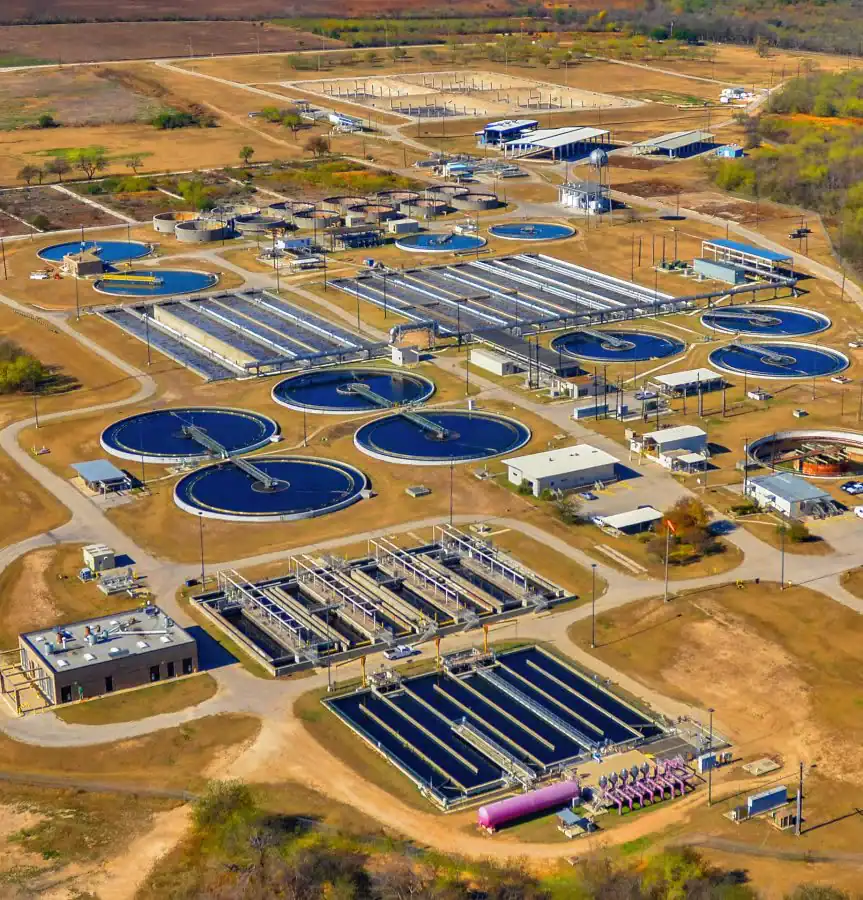
Fractionation units and distillation columns present one of the demanding compositional challenges in industrial photography. They are tall, often cylindrical, surrounded by pipe racks and structural steel, and they exist inside environments where the light is rarely cooperative.
The instinct for most photographers is to back up and shoot wide, which is correct, but the execution matters. Wide-angle lenses in the 14mm to 35mm range are the standard tool for conveying the true scale of large structures. At these focal lengths, you can fit the full height of a column into the frame while simultaneously capturing the surrounding infrastructure that gives the image context.
That context is critical. A fractionation unit photographed in isolation loses the sense of scale that makes it impressive. The pipe racks, the access platforms, and the connecting vessels are what tell the viewer how big this thing is.
Lighting is the other major variable. Midday sun on a petrochemical facility is brutal in the photographic sense: harsh shadows, blown-out highlights, and a flatness that makes complex three-dimensional structures look two-dimensional. The solution is timing.
Golden hour, the period after sunrise and before sunset, produces soft, directional light that wraps around cylindrical structures and creates depth. Blue hour, the window of twilight before the sun rises or after it sets, is effective at facilities that operate 24 hours a day, because the ambient light balances with the artificial lighting of the facility. The result is imagery that feels alive, not archival.
When shooting in environments with extreme contrast, such as a flaring stack against a dark sky or a brightly lit control room visible through an exterior window, HDR bracketing is the practical solution. By capturing multiple exposures of the same frame and combining them, you preserve detail in both the brightest and darkest areas of the image. This is standard practice for managing the dynamic range of industrial environments, and it is one of the reasons industrial photography requires a different technical approach than commercial work.
Pipelines and storage terminals present a different set of compositional problems than vertical structures. The challenge with a pipeline corridor is not height; it is length. A gathering system or transmission line can stretch for miles, and the photograph needs to communicate that without showing miles of pipe.
The effective approach is to use perspective compression intentionally. A longer focal length, used selectively and in contrast to your wide-angle work, can stack the repeating elements of a pipeline corridor and create a sense of depth and scale that a wide shot cannot achieve. Leading lines are your primary compositional tool here: the pipeline itself, the right-of-way corridor, and the row of isolation valves or metering stations that mark intervals along the route. The eye follows those lines into the distance, and the brain interprets that depth as scale.
Storage terminals, tank farms, LNG storage, and NGL storage, require a different approach. The visual challenge is that large cylindrical tanks, photographed from the ground at close range, look squat and unremarkable. Elevation changes the equation. A slightly elevated shooting position, even from a berm or a structure within the facility, gives you a sight line across the top of the tanks and reveals the true footprint of the installation. When you can show forty tanks stretching to the horizon, the scale communicates itself.
Safety and access considerations are inseparable from the photography at these facilities. Storage terminals and pipeline infrastructure in Harris County’s eastern industrial corridor, running through Pasadena, La Porte, Deer Park, Baytown, and Channelview, are among the security-conscious environments in the country. TWIC card access is frequently required for unescorted entry to maritime-adjacent facilities along the Houston Ship Channel.
Without that credential, a photographer must be escorted at all times by an operations employee, which limits where you can go, how long you can stay, and what you can capture. That is not a minor inconvenience; it is a constraint on the quality of the work.
We have held a current TWIC card and have been producing photography and video in Harris County’s industrial sector since the oil and gas boom of the 1970s and 1980s. Refineries, offshore rigs, and petrochemical plants are familiar territory. That matters practically: you are not spending half your production day on safety briefings and access logistics.
Want live answers?
Connect with a Joe Robbins Photography expert for fast, friendly support.
The Houston market has no shortage of commercial photographers. Finding one who can work inside an active petrochemical or midstream facility is a shorter list. The credentials that matter are not the ones on a photography school diploma; they are the ones that determine if a photographer can get through the gate and work safely once they are inside.
Portfolio specificity is the first filter. A photographer who has shot corporate headshots and product photography may produce technically competent work, but that experience does not translate to a refinery or a pipeline terminal. You want to see images of facilities similar to yours, not industrial photography in the abstract, but the specific type of infrastructure you need documented.

This is one of the common questions we hear from marketing and communications professionals at energy and petrochemical companies in Harris County, and it is the right question to ask before you hire anyone.
At a minimum, a photographer working in Harris County’s downstream and midstream facilities should hold a current TWIC card. The Transportation Worker Identification Credential is issued by the TSA and U.S. Coast Guard and is required for unescorted access to secure areas of maritime facilities, outer continental shelf facilities, and regulated vessels.
The Houston Ship Channel corridor, which accounts for approximately 40% of total U.S. petrochemical production capacity, is heavily regulated under the Maritime Transportation Security Act, and many of its facilities require TWIC card access as a baseline condition for any contractor on site.
Beyond the TWIC card, many facilities require OSHA 10 or OSHA 30 certification before permitting contractors into active work areas. Site-specific safety inductions, permit-to-work compliance, PPE requirements, and commercial general liability insurance are standard expectations at most major petrochemical and refinery sites in the region. A photographer who treats these requirements as obstacles, rather than as the operating conditions of the job, is a liability, not an asset.
The practical implication is straightforward: when you are evaluating an industrial photographer, ask about their safety credentials and their experience with site-specific induction processes. A photographer who has not navigated a permit-to-work system at an active facility will slow your production day down and may create safety concerns that reflect poorly on the people who brought them on site.
We have been navigating these requirements in Harris County’s industrial sector since the 1970s. The safety culture at a refinery or a petrochemical plant is not something we need to be briefed on; it is the environment we have worked in for decades.
This is where the business case for professional industrial photography becomes concrete. A single shoot at a major facility can generate imagery that serves your marketing team, your investor relations department, your internal communications team, and your trade show presence, often for multiple years.
The Houston Ship Channel is the largest petrochemical complex in the United States and the second largest in the world. The facilities along its 52-mile corridor handle more than 230 million tons of cargo annually and contribute $15 billion in annual export value. These are not modest operations, and the photography that represents them to investors, customers, and the public should reflect that scale.
Generic stock imagery of refineries, which could be any facility in any state, does not do that. It signals that the company does not have access to its own infrastructure or does not consider its visual representation a priority.
Annual reports for energy and petrochemical companies are one of the primary use cases for high-quality industrial photography. Investors and analysts reading these documents are evaluating the physical assets behind the financial performance. Images that convey operational scale, technical sophistication, and workforce competence support that evaluation in ways that financial tables cannot.
For marketing and business development, strong industrial photography communicates capability before a conversation starts. When a potential client or partner visits your website or reviews your capabilities presentation, the imagery they see shapes their initial impression of your operational scale and professionalism. In a sector where projects are awarded based on demonstrated capability and track record, that first impression carries weight.
The same images that anchor your annual report can be resized for your LinkedIn presence, formatted for your trade show displays along the I-10 Energy Corridor, embedded in your investor relations microsite, and used in internal training materials. The cost of a professional shoot, spread across that range of uses and the years those images remain current, is typically among the efficient marketing expenditures a company in this sector makes.
The facilities along the Houston Ship Channel, through Pasadena, La Porte, Baytown, and out into the eastern industrial corridor, represent some of the complex and consequential infrastructure in the world. The photography that represents those facilities should be made by someone who understands them, not just visually, but operationally.
Wide optics and dynamic lighting are the technical foundation. Safety credentials and access experience are the practical prerequisites. Decades of sector-specific knowledge are what turn technically correct images into imagery that performs for your business.
If you are looking for an industrial photographer who has been working in Harris County’s energy and petrochemical sector since before most of its current facilities were built, we are worth a conversation. Reach out and let’s talk about what your project needs.
Need authentic, safety-compliant industrial imagery or executive portraits for your energy firm? Schedule a consultation with Joe Robbins Photography.
Summary:

Article details: